Every summer the northern resident orcas come back to Johnstone Strait, the channel between the top of Vancouver Island and the mainland islands, because the salmon do. They have done it for as long as anyone has kept records, and since the humpbacks returned to this coast they have shared the water with whales three times their size. It is the most dependable whale water in British Columbia, and the two camps I have paddled from and the lodge I have flown into all sell the same short season on it. This is how that season works, where you may and may not go, what a kayak gives you that a boat does not, and which of the three ways on this record I would send you on.

Nobody can promise a wild animal. What a camp on Johnstone Strait gives you is position: the right shoreline, in the right weeks, for days at a time rather than hours.
The reserve you may not enter
Robson Bight is a bay on the Vancouver Island side of the strait with a length of smooth gravel shoreline in its shallows. The northern residents come there to rub their bodies on the stones, and it is the only reliable rubbing-beach complex known anywhere. It became the Michael Bigg Ecological Reserve in 1982, named for the biologist who first told the orcas apart by their fins, and the protection is simple: no boats, no kayaks, no landing. The whales get the bay to themselves.
That single rule shapes every trip in the strait. The camps are placed at its edges. Wildcoast Adventures pitches Orca Camp on the beach directly beside the reserve; Spirit of the West Adventures runs its Johnstone Strait camp across the water on West Cracroft Island, looking straight at it. You do not go into Robson Bight. You wait outside it, on the water or on the beach, for the whales to come out along the shore, and they do, because the shore is the road.
On the water the guides keep to the marine mammal regulations, which set the distance a boat or a kayak may approach a whale. In practice the rule is that you stop paddling and the whales choose. I have watched a guide raft a whole group together and hold it still on the water, and it produces the correct relationship: the whales run the encounter and you are grateful.
When: the season as the operators publish it
The operators are careful about dates, so I will be too. Wildcoast’s Orca Camp runs from 1 July to 17 September, with departures every three days to 14 September and every date guaranteed to go. The lower price is on the first three departures and the September ones; the peak weeks from 10 July to 30 August cost more and carry a single fee for solo travellers. Spirit of the West’s Johnstone Strait Glamping camp departs every three to six days from 6 July to 10 September, its paddle-in Johnstone Strait Expedition every three days from 21 July to 17 August, and its Whales and Wilderness Glamping camp on Blackfish Sound, one channel to the north, from 13 June to 17 September, all for 2027. Knight Inlet Lodge, which is a grizzly lodge first, offers a full-day whale run to Johnstone Strait from mid-July to the end of September on packages of 4 nights and up.
Put those together and you have July, August and the first half of September as the shared window, with the shoulders on either side belonging to one operator or another. Spirit of the West puts the humpbacks in the strait from roughly July to October; Wildcoast says its dates are pinned to historically good months and that the whales decide. Both are honest, and both calendars say the same thing about the middle of the season: the whale weeks sell first. Six of the eight July and August departures of Spirit of the West’s flagship camp for 2027 were already full when I read the calendar in September 2026.


Two camps, one strait
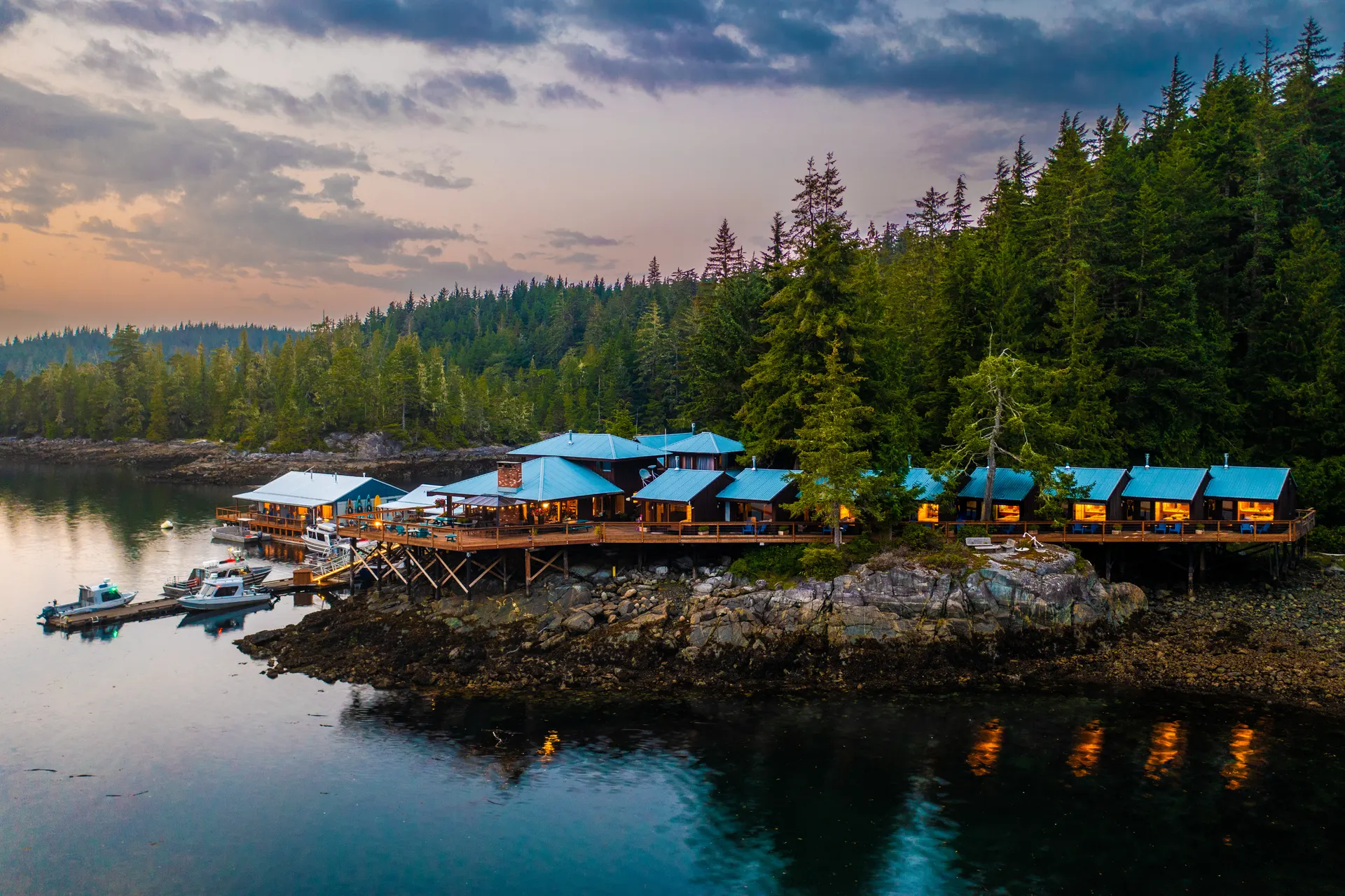
Orca Camp from three hundred feet, on the Vancouver Island shore beside the reserve. Everything in the frame came in by barge and goes out the same way at the end of the season.
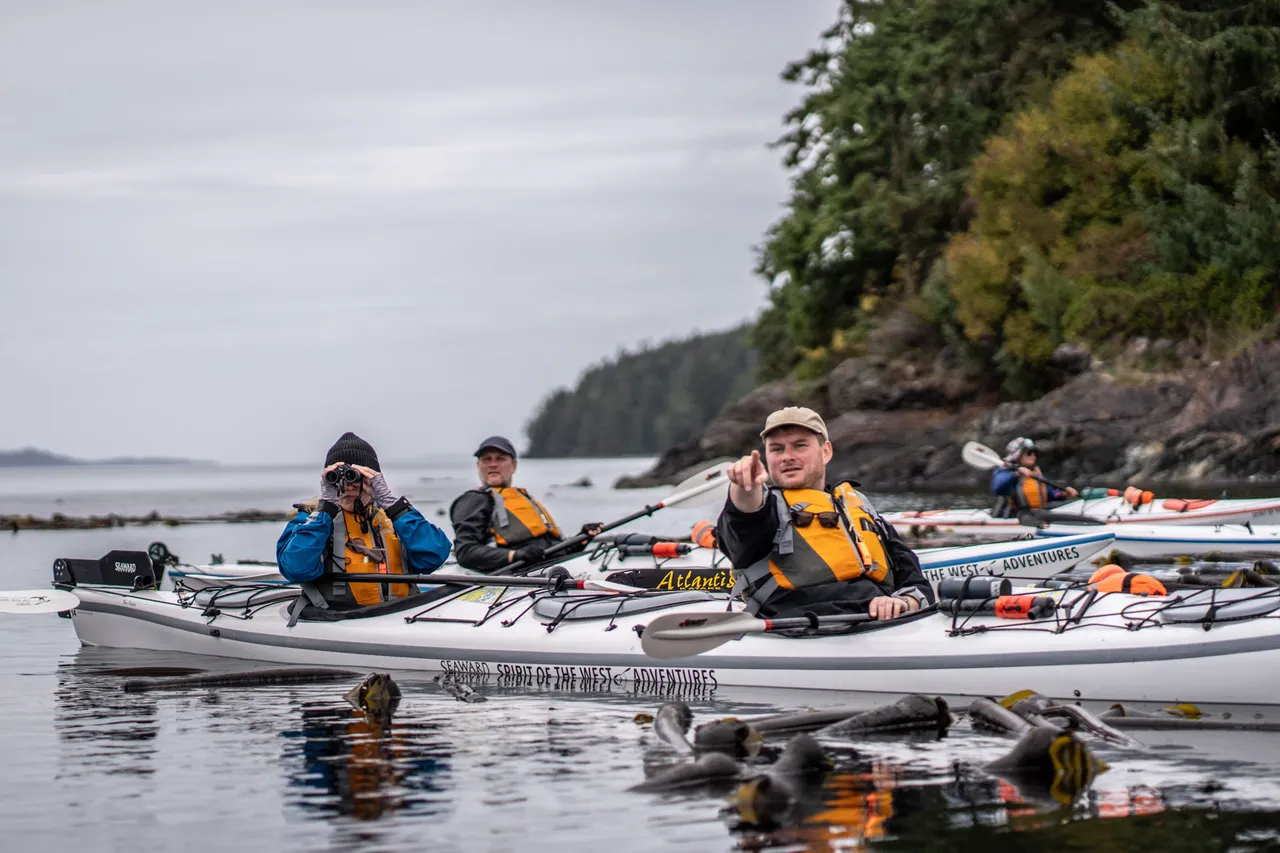
A Spirit of the West group coming ashore for lunch. Their Johnstone Strait camp faces the reserve from the far side; their flagship camp is on Swanson Island in Blackfish Sound, where the same whales go next.
From a kayak, or from a boat
I have filmed whales from boats, from drones and from shore, and from a sea kayak, and the kayak is the one I cannot reproduce with equipment. Eighteen inches off the water, engineless, a humpback exhales half a kilometre away and you hear it before you see it, a pressurised sigh rolling across the flat. From a boat you are spectating. From a kayak you are, briefly, a fellow resident. That is the whole argument for a paddling week, and it is a good one.
The argument for a boat is arithmetic. A covered boat covers more of the strait in a morning than a kayak group covers in three days, so the odds of finding whales on any single day are higher, and the day is shorter, warmer and drier. The whale run from Knight Inlet Lodge is that kind of day: a long one, out of the inlet and down to the strait and back, which is why the lodge only offers it on stays of 4 nights or more. The 3-night package is too short for it.

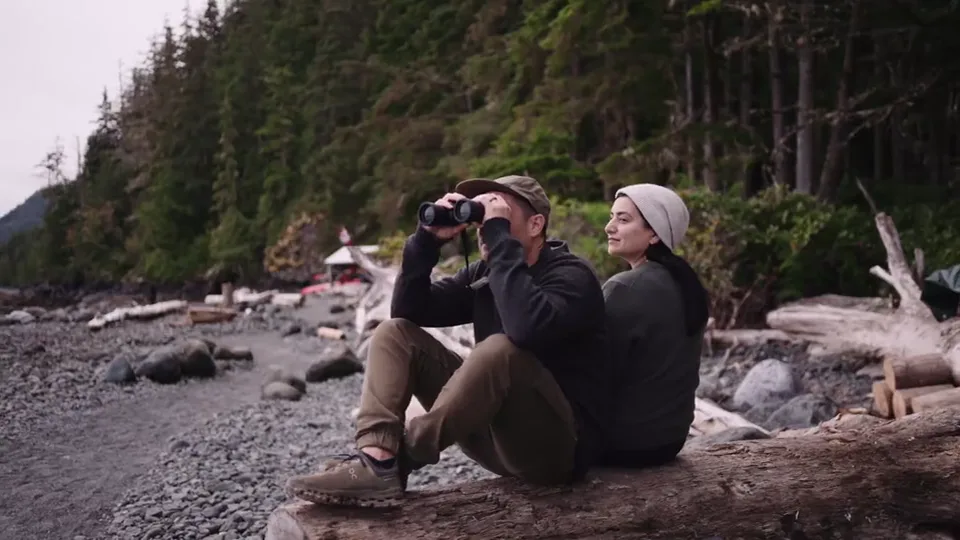
There is a third seat, which is the beach. At Orca Camp the whales pass the camp itself, and a day spent on a driftwood log with binoculars is a legitimate day; Wildcoast says so in its own copy, and on my trip the people who sat out the afternoon paddle were not the ones who missed anything. A base camp is the only kind of trip where that is true.
Whale watching from a boat is spectating. From a sea kayak it is being, briefly, a fellow resident.
From the Spirit of the West week
The three ways on this record
Orca Camp, with Wildcoast Adventures. A tented base camp on the beach directly beside the reserve, 18 guests, three guides, a water taxi from Campbell River at half past seven in the morning. Four days and three nights, $2,491.86 per person sharing a tent on the early-July and September departures and $2,797.86 from 10 July to 30 August, before 5% GST, with everything in the price: the taxi, the tent and bedding, every meal, the kayaks and the guiding, and a wood-fired hot tub and sauna at the end of the day. Departures every three days, all guaranteed to go. This is the one I would send a first-timer on, because the paddling asks nothing of you, the whales pass the beach itself, and you cannot leave early. The story of the camp is on the record.
Spirit of the West Adventures, from Quadra Island. Two honest kinds of trip. The base camps stay put, with walk-in canvas tents on platforms, real beds, hot showers and a hot tub: Johnstone Strait Glamping on West Cracroft Island across from the reserve, $2,595 for 4 days and 3 nights, and Whales and Wilderness Glamping on Swanson Island in Blackfish Sound, $3,295 for 5 days and 4 nights, with a chef. The expeditions move camp with everything in the hatches: the Johnstone Strait Expedition paddles in from Bauza Cove with no water taxi, $1,795 for 4 days and 3 nights, the cheapest way onto this water on the record. All prices are for 2027, per person, before GST and a $25 sustainability fee, and there is no single supplement on any of them. The week I spent with them is where the humpback sigh comes from.
A whale day from Knight Inlet Lodge. A floating grizzly lodge at Glendale Cove, reached by floatplane from Campbell River, with the full-day whale run to Johnstone Strait as one of the excursion choices from mid-July to the end of September on packages of 4 nights and up, weather permitting. You go for the bears and take the whales as a long day out. The Ledger on the listing has the package grid; the 4-night packages are the ones the whale day fits.

The long day out
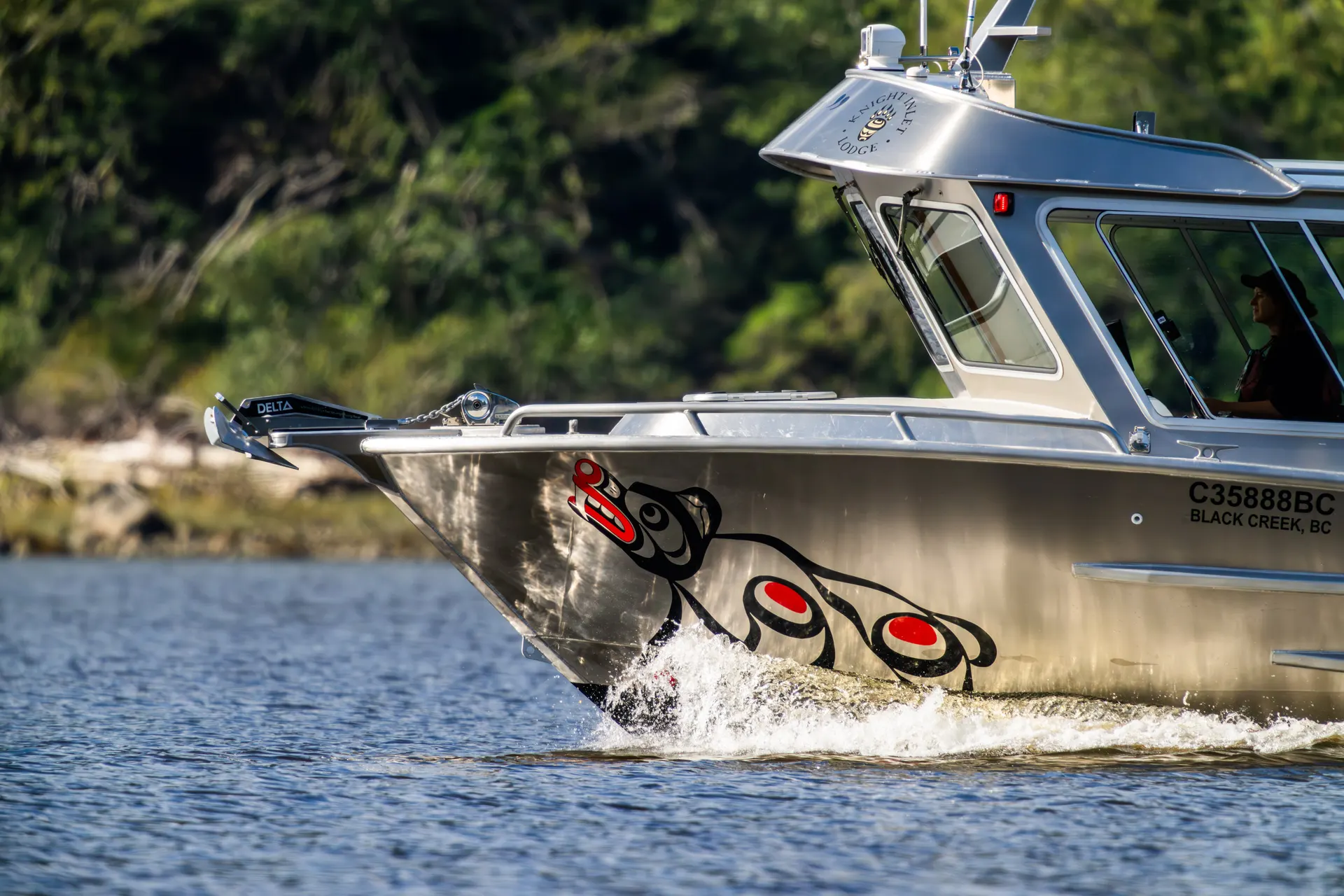
Knight Inlet's covered boat, which is what the whale day runs on. It is the same boat that drifts the estuary for bears on a spring morning.
Steller sea lions are the reliable part of any boat day on this coast; the whales are the part you hope for.
If it is a straight choice between the two kayak camps, the side-by-side comparison puts their published prices, inclusions and terms in one table. The short version: Wildcoast is the one camp beside the reserve with the water taxi and the guaranteed departures; Spirit of the West has the cheaper paddle-in expedition, the flagship camp with the chef, and no single supplement anywhere.

The strait at the end of the day
What to take from this
Book July, August or the first half of September, and book it early, because the whale weeks go first. Choose a base camp if you want the beach as a third seat and a bed that is dry when you get back to it; choose the expedition if you want the cheapest three nights on the water and do not mind carrying the camp. Choose the boat day from Knight Inlet if bears are the reason for the trip and the whales are a bonus. And give it more days than the minimum. The reserve is closed, the whales are on their own schedule, and the only thing you control is how long you are there when they come out along the shore.
The sea kayak packing list is the one I packed from for Orca Camp, and if you have never sat in a sea kayak, what a guided camp actually asks of you is the honest answer.